
Ijen Crater
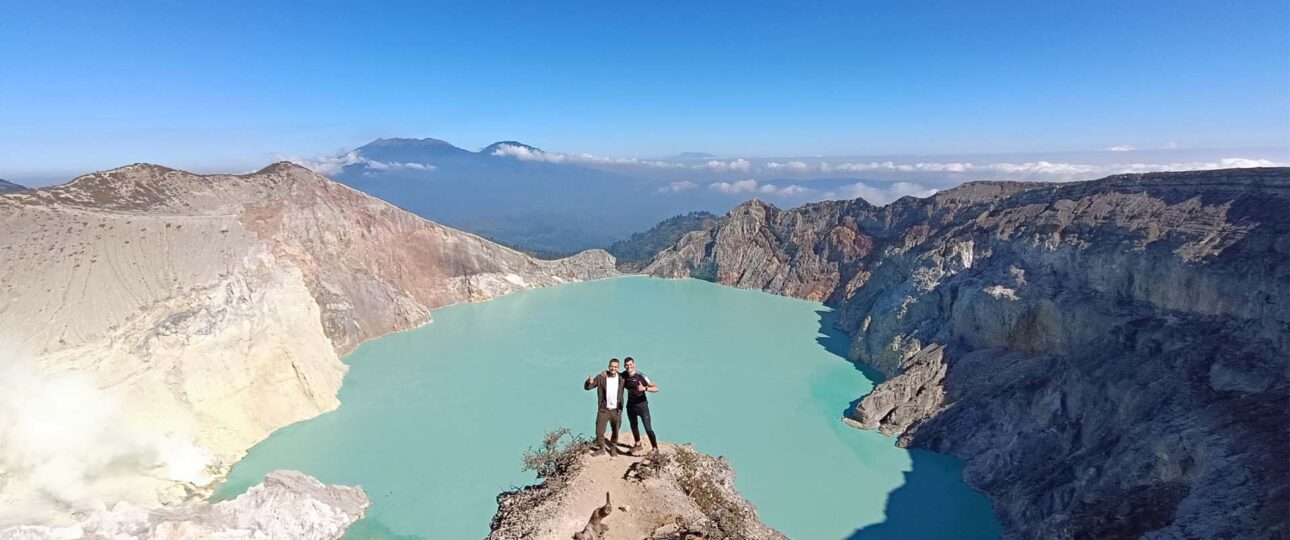
The Ijen volcano complex is a group of composite volcanoes located on the border between Banyuwangi Regency and Bondowoso Regency of East Java, Indonesia. It is known for its blue fire, acidic crater lake, and labour-intensive sulfur mining. Ijen is an active volcano in East Java famous for its blue fire, a turquoise, tranquil, but highly toxic crater lake, and sulfur miners. It is one of the most amazing extra-terrestrial places on Earth.
Why Should You Visit Ijen
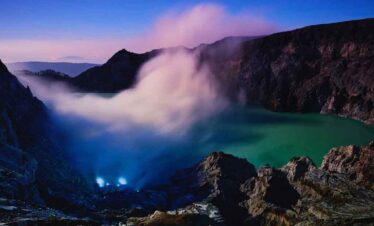
1. Blue Fire (Blue Lava)
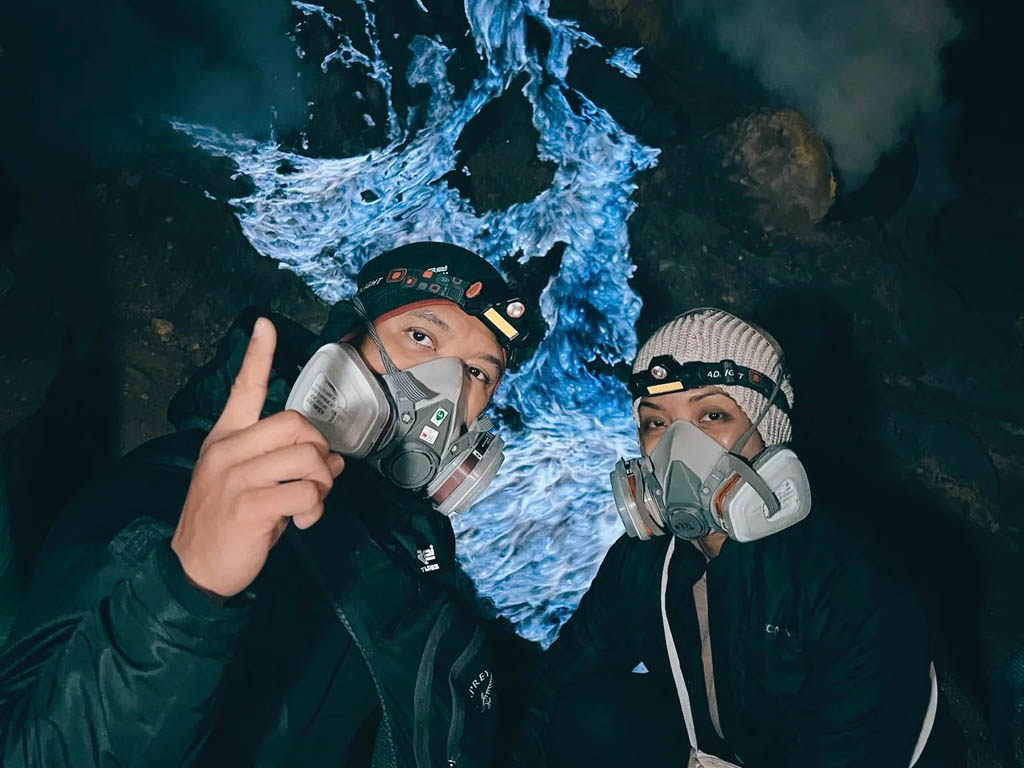
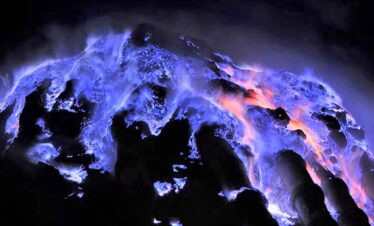
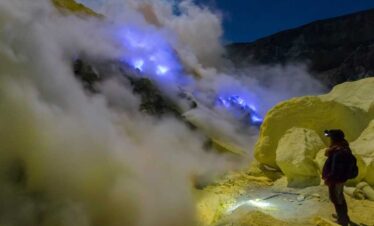
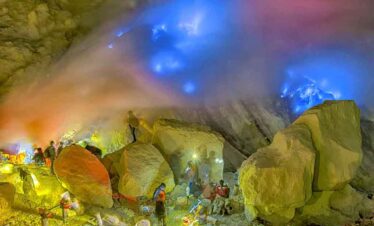
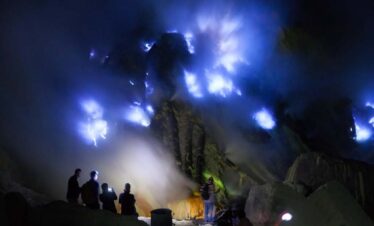
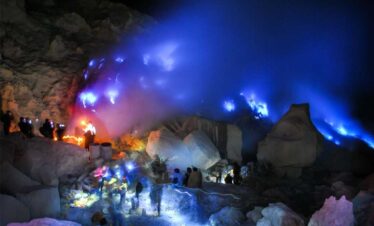
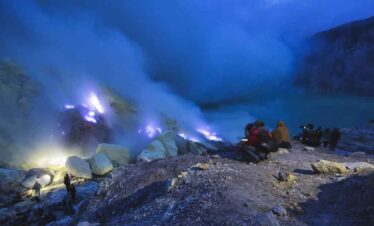
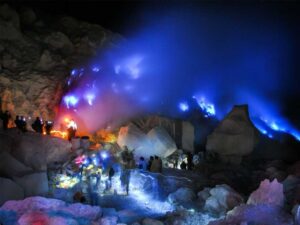 The Ijen volcano has some of the highest levels of sulfur in the world. Because the sulfur can spews “blue lava”, unusual for a volcano. This blue glow isn’t real lava. The glow is actually the light from the combustion of sulfuric gases. Those gases emerge from cracks in the volcano at high pressure and temperature—up to 600°C. When they come in contact with the air, they ignite, sending flames up to 5m high. Some of the gases condense into liquid sulfur, which continues to burn as it flows down the slopes, giving the feeling of lava flowing.
Unlike regular volcanoes whose bright red lava is visible in the day, Kawah Ijen’s blue burning flames can only be seen at night. The burning happens day and night, but it’s visible only in darkness. The best time is between 2-4 am, that is why you need to start your tour very early, around 1 or 2 am. The vision of these flames at night is strange and extraordinary, and you will feel like on another planet.
There is no guarantee that you will see blue fire during your trip. The conditions need to be just right with no wind and hot internal temperatures in the vents. According to National Geographic, the miners sometimes ignite the sulfur and/or sulfur gases to produce the blue flames that are so prominent in nighttime photographs.
This phenomenon is very rare as there are only very few places in the world that this happens. Regularly on Mt Ijen and in Ethiopia only. Irregularly in Yellowstone and Hawaii (during wildfires or eruptions). That’s why it is so special.
2. Crater Lake
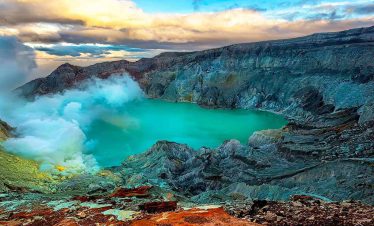
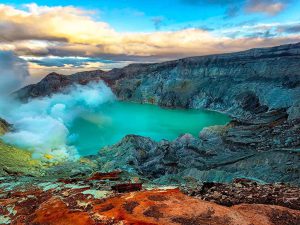 The turquoise lake in the crater of the Kawah Ijen volcano looks serene and inviting. However, it also happens to be the world’s largest acidic lake. The water in the crater lake has a pH of less than 0.3 on a scale of 0 to 14 (7 is neutral). In fact, it’s the acid that makes the water green.
Can you swim in the Kawah Ijen? No, the lake is a 90 C pool of sulfuric acid in which nothing lives, and which would kill any that dared to swim in it. Birds have been reported to drop dead from the lake’s fumes and to fall into it if they fly overhead.
3. Sulfur Miners
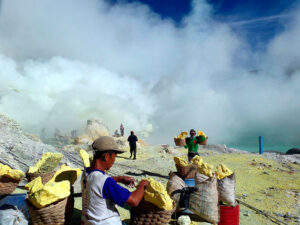 The Ijen volcano complex is home to one of the world’s most dangerous sulfur mining operations in the world. You can see men carrying two baskets made out of bamboo loaded with mustard-yellow sulfur on their shoulders. There were about 20-30 miners on the day we were there.
Miners have been extracting sulfur here since 1968. At times they work at night under the eerie blue light to escape the heat of the sun, and to earn extra income.
The miners extract the sulfur rock, which is formed after the blue flames extinguish leaving behind a solid sulfur-rich rock. They then carry these large loads in baskets down the side of the mountain to be paid per kg. Each load has 80kg and I couldn’t even lift it! The workers don’t look like Rambos, but they can carry this weight on their shoulders up to the rim thru a path that is actually closed for tourists because it is dangerous!
Let’s do the math: Sulfur miners are paid Rp 1000/kg. They usually take 2 daily trips (80kg each trip), so they can bring max 160kg/day, so max Rp 160 000/day. (11 USD). It is very little by European standards, but mining is one of the highest-paid professions in the region, and the workers are well-respected members of their communities. But they bear the scars of years spent on the edge of life and death. The side effects are nothing less but severe burns, sore bodies, ongoing coughing, poisoned lungs, and squashed shoulder bones. Average life expectancy barely exceeds 50 years. But the money keeps them going and when one has the opportunity, he saves up as much as he can, and after a few years, opens a guesthouse and becomes a tour guide (guide earns Rp 250 000/day).
From where comes the sulfur? As the burning gases cool, they deposit sulfur around the lake. To speed up the formation of the mineral, a mining company installed ceramic pipes on an active vent near the edge of the lake. The pipes route the sulfur gases down the vent’s sloping mound. When the gases cool, they condense into liquid sulfur, which then flows or drips from the pipes and solidifies in few minutes into hard sulfur mats. After the solid sulfur cools, the miners break it up and haul it off the mountain on their backs.
Sulfur stalactites sometimes form from the liquid sulfur dripping from the pipes. These are collected and sold to tourists. You can buy them to help the miners, but please remember that you cannot take them to the airplane. If you are using Banyuwangi airport count that it will be confiscated. You might be ok if your flight is from Bali airport, but in Banyuwangi airport they are really checking for sulfur.
Mount Ijen hosts one of the last remaining active sulfur mines in the world, and in recent decades the miners themselves have become a controversial tourist attraction. Please step on a side if you are passing a miner, as his load is really heavy!
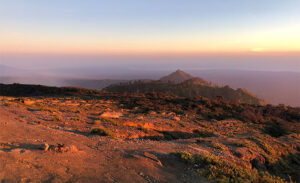
4. Sunrise on Mt Ijen
What to bring for Ijen Trip
Trekking or sport shoes, warm cloth with many layers (long trousers, trekking t-shist, turtleneck, fleece sweater and thin wind-stop jacket, winter scarf, winter cap, and gloves), headlamp, spare batteries, normal mask, small money, wet tissue, water, energy bars, raincoat, sunblock, camera, personal items (e.g. medicine), no jewelry (sulfur might damage it, silver will turn yellow).
If you do not intend to start your hike early in the morning, the necessary items are steady shoes and light jacket and raincoat. The path can be very slippery on the way down, so good shoes are a must. It might be drizzling along the way, and the wind is strong at the rim which can make you very cold.
Hiking Ijen
Part 1 – From Base camp to the Rim/Blue Fire Viewpoint (4km, 90 – 120 min)
Tourists usually start at midnight or 1 am, in order to see the blue fires. Blue fires are nicest during dark, between 2-4 am. We started at 3 am, as during pandemic the park is open only from 3 am-12 pm.
The first part is wide road with no rocks, easy to walk, but sometimes pretty steep. If you run out of breath, just make a break and continue. The last 30 minutes is easy and mostly flat.
This part is doable by anyone. I would say even for children 6+ (but I wouldn’t take little kids to Ijen due to toxicity. You never know how the wind blows). If you don’t like to hike, you can take a human taxi (trolly pushed and pulled by 3 men, Rp 1.000 000 both ways). There are many at the beginning of the hike and some on the way up.
There are 2 stations to take a break.
When you reach the rim, there is a Blue fire viewpoint, from where you can observe the magical blue fires from a safe distance. Sulfur miners will be passing by you.
It might be quite windy on some parts at the top.
Part 2 – From the Rim to the Caldera (50 min down, 50 min up)
If you find it dangerous you can skip this part.
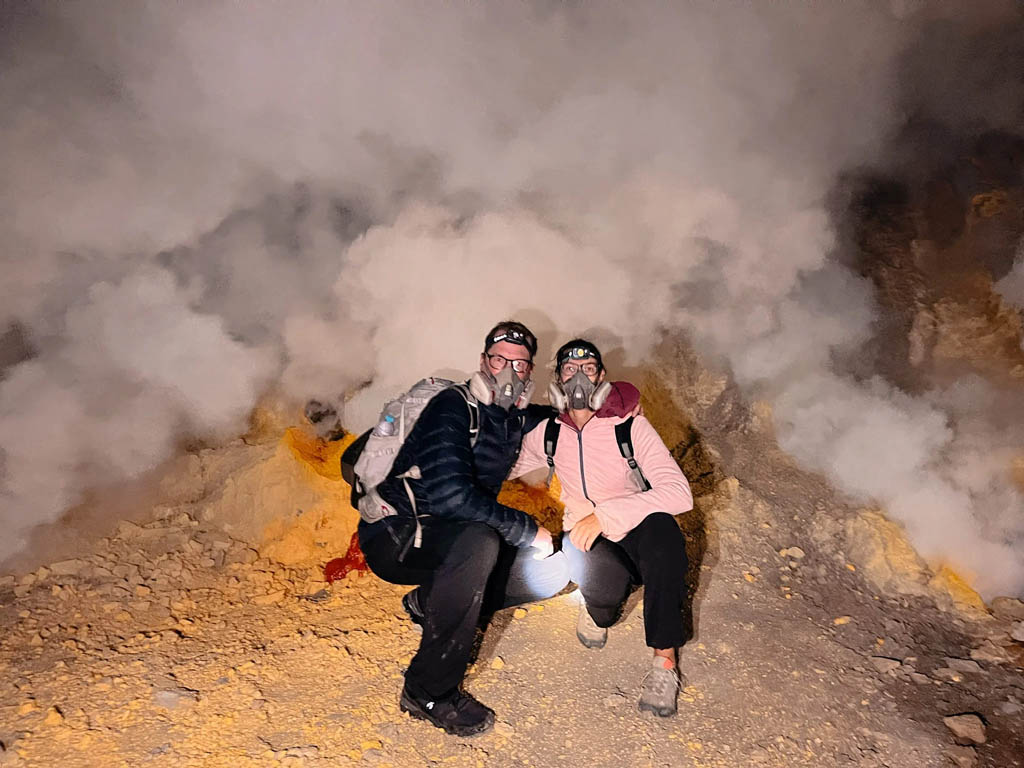
This path is forbidden already many years, but tourists use to ignore it. This is a difficult, toxic, slippery, and dangerous trek. It is steep and stones can be rolling. You need to be fit, have good shoes and a gas mask (and googles). Go carefully, at your own pace, watch your steps. Your security is very important.
You might use poles here. There is no taxi. Definitely not for children. Close to the lake, you will see blue fires and sulfur miners working. Blue fires are nicest during dark, between 2-4 am.
Sulfur clouds are unpredictable and can change direction any minute with the wind. Sometimes it’s so thick you can’t see or breathe. If that happens, we were advised, don’t panic—just wait for the wind to move it along.
Part 3 – Sunrise trek on the rim (30 min)
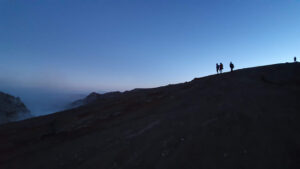
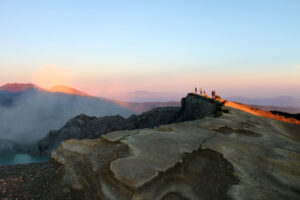
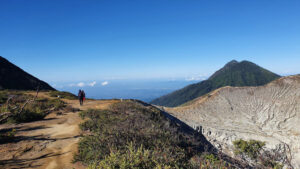
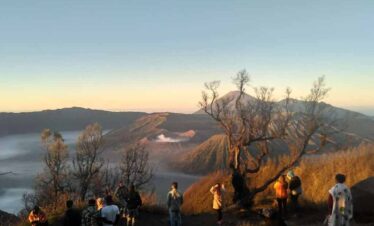
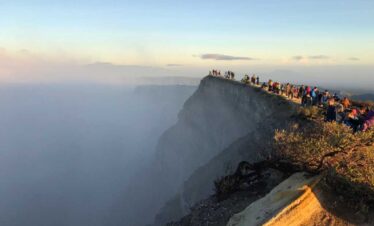
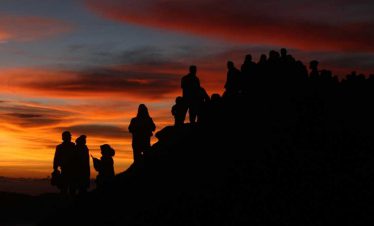
After Blue fire viewpoint on the rim, you can continue another 30 min to the other side of the rim to see the sunrise and take some amazing pictures. This path is not difficult, but I consider it very dangerous as you can easily fall from the rim to the crater. Many tourists are taking pictures on the edge of the rim and I am surprised that nobody died yet while taking a selfie. This part is ok only for children that obey their parents (but as I said, I wouldn’t take my kids to Ijen due to toxicity. You never know from where the wind blow). No taxi here.
Where is Kawah Ijen?
Kawah Ijen (2386 m) is in Banyuwangi regency, East Java province, Indonesia. Relatively close to Bali island.
When to go?
Best time to visit Ijen: During the dry season which mostly starts from April until the beginning of November. However, July to September is a favorite time for tourists and it might be crowded.
If you can, go on weekday (weekends are more crowded).
Trek during the night if you want to see the blue fire. It will be gone at 5 am in the morning.
The worst time to visit Ijen: Start from the end of December until March, there will be more rain that will start from morning until night. If you can, try to avoid the holidays and long weekends, because a lot of people will be along the trail leading from the base camp to the crater rim during those periods.
Where to Stay?
Licin (village on the way to Ijen, lot of nature, forest, rice paddies, beautiful)
Ijen Resort and Villas (hotel in Licin, on the way to Ijen) and 1 night at eL Hotel Royale Banyuwangi (hotel in the city Banyuwangi, 15 min from the airport).
Kampoeng Joglo Ijen (hotel in Licin, on the way to Ijen).
Banyuwangi (city 15 min from the airport, 1h from Ijen Base camp).
There’s plenty of hotel in Banyuwangi. We stayed at eL Hotel Royale Banyuwangi
No sleep
Some people don’t even sleep around Ijen. They just arrive late (e.g. from Bali), start trek at midnight and return to Bali right after the hike.
What are the recommended attractions near Ijen?
Relaxing walk around your hotel
In case you are staying in Licin (village between Banuywangi and Ijen, full of greenery) as we did, take a relaxing walk around your hotel. Some hotels (e.g. Ijen Vila and Resort, Kampoeng Joglo Ijen) offer a 2 hours trip around thru paddies, forests, and villages with a guide.
Baluran National Park
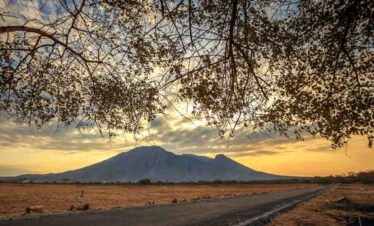
Baluran National Park is the biggest Savanna in Asia, well-known as The Africa of Asia. Read more about Baluran here.
De Djawatan Forest
Feel like in the film The Lord of the Ring.
Breathtaking 100-years old tree alley. The ferns hanging from tree branches add to the uniqueness and beauty to the forest. Standing under the De Djawatan trees, visitors will feel like they are in a mysterious fairytale. Very instagramable.
In the past, here was an old building that was used as a place to manage manual trains.
Access is very easy, only about 30 min from Banyuwangi, located next to the main road.
Pantai Pulau Merah
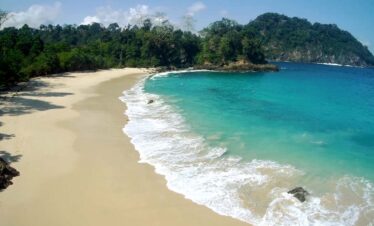
We were surprised by how beautiful, long (3km!), and clean the beach was.
Don’t expect to see any red or pink beach. Just the green hill opposite the beach has some brown-reddish stones. The hill can be visited on foot during low tide.
The waves were small and pleasant on the left side of the beach, in front of the restaurants. However, in the middle of the beach the waves are stronger, so be careful. It is an ideal place for beginner, amateur, and professional surfers with an average waves of 2m. In rainy season (Dec, Jan) waves can reach 5m.
We ordered lunch in a local restaurant at the beach, walk a bit, swim and eat. The fish (Napoleon) was delicios. Changing rooms and toilets were “challenging”.
Last 20 km of the road could be in a better condition.
We were the only tourists (weekday, mid day), but I can imagine that it is a popular destination for locals over the weekend.
FAQ
Is Ijen an active volcano?
Yes, Mount Ijen is an active volcano. It is one of several active stratovolcanoes constructed over the 20 km wide Ijen caldera, the largest caldera in Java.
Eruptions from Ijen are very hazardous because of the risk of the lake draining to form catastrophic lahars.
How often does the Kawah Ijen volcano erupt? When did Ijen last erupt?
The volcano remains active. The last magmatic eruption occurred in 1817. Phreatic eruptions occurred in 1796, 1917, 1936, 1950, 1952, 1993, 1994, 1999, 2000, 2001, and 2002. These have caused very little damage but present a danger to anyone mining sulfur or visiting the caldera. (Source: https://geology.com/volcanoes/kawah-ijen/)
What is special about the Kawah Ijen (Ijen Crater) volcano?
Blue Lava, the world’s largest acidic lake and sulfur miners
What is the most acidic lake in the world?
The turquoise lake in the crater of the Kawah Ijen volcano is the world’s largest acidic lake. The water in the crater lake has a pH of less than 0.3 on a scale of 0 to 14 (7 is neutral).
Is Blue Lava real?
The blue glow isn’t lava, as can be read on many websites. The glow is actually the light from the combustion of sulfuric gases that condense into liquid sulfur, which continues to burn as it flows down the slopes, giving the feeling of lava flowing.
Why does Kawah Ijen (Ijen Crater) have blue lava? What causes blue lava?
The Ijen volcano has some of the highest levels of sulfur in the world. It spews blue lava (what is actually not lava, just blue flames). The blue, unusual for a volcano, is due to the presence of an active solfatara (a natural volcanic steam vent) that emits strong gases with high levels of sulfur. Some of the gases condense into liquid sulfur, which continues to burn as it flows down the slopes, giving the feeling of lava flowing.
Can you make blue lava at home?
Yes, you can, but be super careful! It smells like hell and it is probably dangerous (sulfur is used in gunpowder). Buy sulfur from a miner, make it into a powder and light a small amount of it at night on a plate, like in this video (from minute 7:50):
Where on the Earth can you see Blue Lava?
Regularly on Ijen (Indonesia) and Dallol (Ethiopia) only.
Sometimes could be observed in Yellowstone National Park during wildfires and on Kīlauea (Hawaii) during the volcano’s Puna eruption.
What is sulfur used for?
Sulfur is used to manufacture countless products—from matches, rubber, insecticides, and fertilizer to cosmetics, batteries, sugar, and film.
What is the nearest airport to Mt Ijen?
There is a new airport in Banyuwangi, from there it takes only 90 min by car to the Ijen parking area, where you can start your trek.
How long does it take to climb Mount Ijen?
The journey from the parking area to the Ijen crater rim will take about 1.5 – 2 hours. You can finish your journey here or you can go down to the caldera (to see the lake, miners and blue fire from close – 50 min down and 50 min back up.
Is Ijen for Children? Who should not go to Ijen?
The first part of the trek from the parking area to the rim (link) is doable by anyone. I would say even for children 6+ (but I wouldn’t take my kids to Ijen due to toxicity). If you don’t like to hike, you can take a human taxi.
The second part, from the rim to caldera, don’t go if you have any existing breathing conditions (asthma, panic easily when breathing anything other than oxygen, etc.) or have extremely sensitive eyes. Going into and out of the crater is very steep and extremely dangerous. Clouds of sulfur can descend at any time, meaning there is no air to breathe. The water in the lake is like cooking hot. The crater is definitely not for children.
The third part, around the rim to see the sunrise is for anyone, but definitely not for not-obedient children. The edge of the Ijen rim can be dangerous in parts.
Which clothes should I take to Mt Ijen?
Take a warm cloth, many layers, and stop-wind. The temperature on the top can be as low as 11C and if it is windy then it feels really cold. During the day it is around 20C.
It was 16C at night when we were there and the wind was strong on some parts of the rim.
Usually travelers use and wear trekking shoes (sport shoes are fine), long trousers, trekking t-shist, turtleneck, fleece sweater and thin wind-stop jacket, winter scarf, winter cap, and gloves.
Where can we rent the masks?
You need a gas mask only if you plan to go to the caldera. You don’t need a gas mask for the trek from the parking area to the rim and on the rim. Only in the caldera (by the crater lake where are blue fires and sulfur miners).
If you go with a guide or agency, they will help you to rent a gas mask.
As for the rest of the trek you can have a textile mask with you – we didn’t use it and we didn’t feel the sulfur smell in the air, but it might depend on weather conditions.
In case, if for some reason, you don’t have a mask, wear a wet flannel. Sulfur dioxide is very soluble in water. So wet flannels pretty much do the trick.
Will the gasses hurt my eyes?
If you go down to the caldera the gases can also hurt your eyes. Depends on the wind. So you should also think about eye protection. Either use a full-face mask or if you have a half mask (for mouth only) take googles with you. Or you just close your eyes and wait till the wind change.
4WD Jeep Tour




Beach Tour
Caving
Cultural Tour
Horseback Riding
Light Trekking
Safari & Wildlife
Shopping
Sightseeing
Trekking
Visiting Local Product